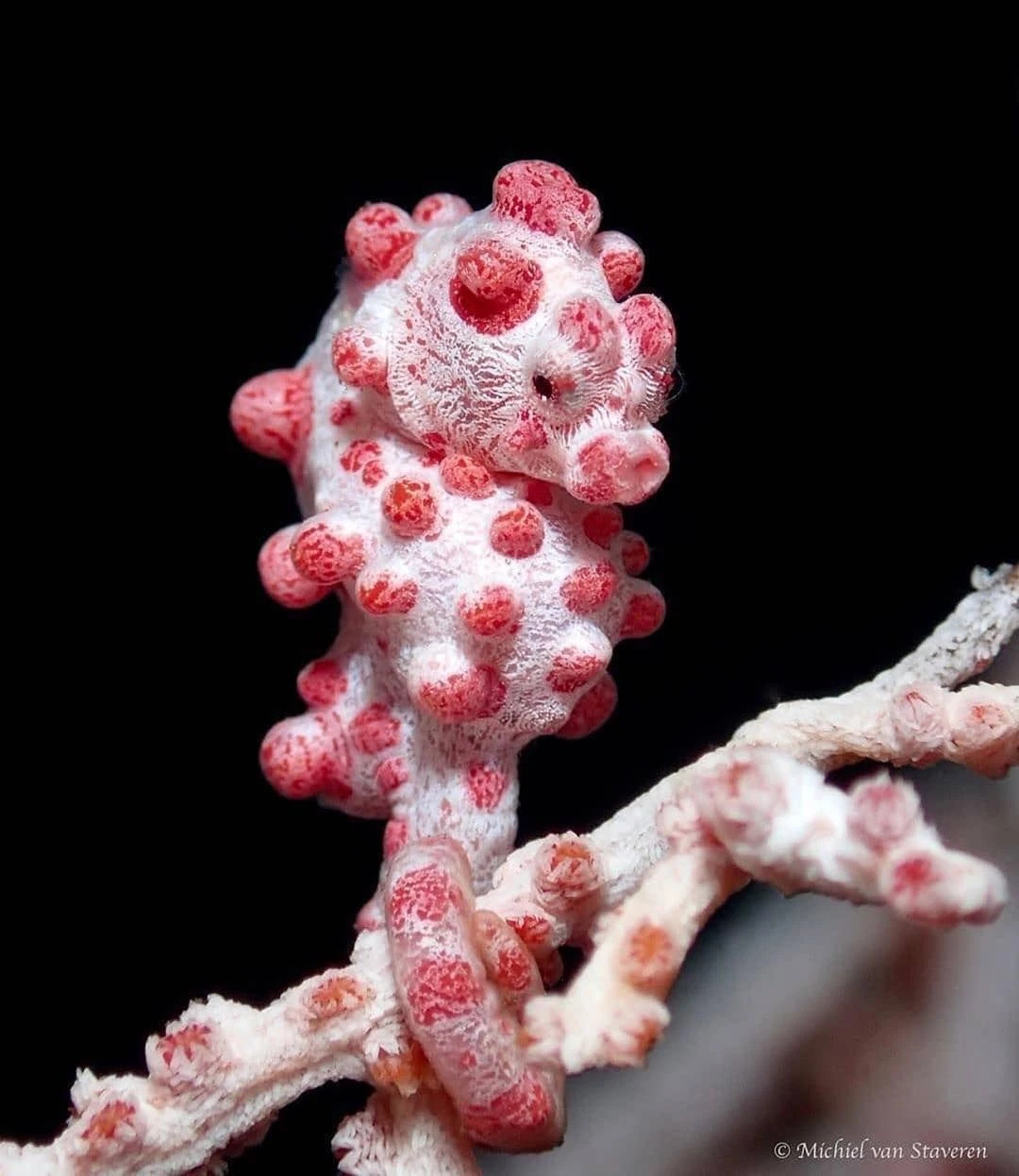
The pygmy seahorse is a type of seahorse species that is known for being tiny, measuring at about 14-27 millimeters as adults, the pygmy seahorse is apart of the Syngnathidae family
(literally the seahorse and pipefish family). Pygmy seahorses are commomnly found in Southeast Asia in the Coral Triangle Area with the seahorse having a strong affinity for hiding in
coral patches. Currently, we have discovered eight different pygmy seahorse types with the first being found in 1969 (Hippocampus bargibanti). The seahorse was only found after New
Caledonian scientist, Georges Bargibant, discovered it while analyzing Muricella specimens, a type of coral. The seahorses' claim to fame is camouflaging in bunches of coral with their
vibrant colors, as you can see, it does a pretty good job at blending in with the coral, being both extremely tiny while perfectly matching the color. We will be discussing each type of pygmy
seahorse while giving a general overview of why they're unique. Bargibant's pygmy seahorse (the first one) is only found on the gorgorian corals of the genus Muricella, these seahorses will
spend their entire life on one piece of coral while being the largest of all the other pygmys. Denise's pygmy seahorse is different from Bargibant's, with it being found on eight different genus
of coral, the seahorse will also spend their entire life on one piece of coral but spends their early days finding a good patch and adjusting their color to it. Pontoh's pygmy seahorse is a free-living
animal, meaning that they are not typically associated with gorgorian coral but can be found in any type of coral reef, being the most open of all the seahorses. Satomi's pygmy seahorse is
the world's smallest seahorse and are also free living, the seahorse is actually nocturnal and is mainly active during the night. Severn's pygmy seahorse's only difference from Pontoh's seahorse
is the color, being a pale brown with red and orange patches, not very original is it? Walea soft coral pygmy seahorse's name describes its main feature perfectly, being the only pygmy seahorse (for now)
that lives exclusively on soft coral, having the massive tail to support living on soft coral's giant branches. Coleman's pygmy seahorse was apparently found living on seagrass, with this being
the most unique feature it has over the other seahorses. Japanese pygmy seahorses are unique because they have a dorsal ridge of triangular mounds, meaning their face looks like a triangle
and is native to soft coral AND algal reefs in Japan, making my clain about the soft coral seahorse still true (for now). Finally, Sodwana pygmy seahorse's most interesting fact is that it was found
unintentionally while looking for other pygmy seahorses and it looks kinda funny, it's also brown. Many people consider any tiny seahorse to be a pygmy, not only is that rude, it's factually incorrect,
what defines a pygmy is not only being tiny, it is the single gill opening it has and the trunk brooding, that is how you find a true pygmy. Pygmy seahorses eat tiny crustaceans with things such as newly
hatched brine shrimp being on the top of their list. Overall, pygmy seahorses are tiny little critters, which allows them to be extremely hard to find not only for predators, but for us as well.
Maybe we'll find twenty more types in twenty years who knows?